Website
Audiovisual production
Branding
Brief guidelines
Manresa, with a population of 77,452, started with an open-container model that had achieved a 47.8% rate of separate waste collection. The City Council opted to shift to a model based on closed containers—accessible via user-identification cards—for household waste, and a door-to-door collection service for businesses.
The communication challenge lay not in explaining how the new containers worked, nor in turning the rollout into a debate about the system itself.
Instead, the change had to be framed within a broader context linked to the fight against the climate emergency; the focus needed to be placed on the desired outcomes, and the public had to be encouraged to view the new model as a shared responsibility.
The campaign had to reduce the perception of complexity, generate trust and, above all, connect change with a more emotional experience: being from Manresa.
Strategy and action plan
We started with a simple idea: if the new model was to be embraced by the city, it had to speak from the city’s perspective.
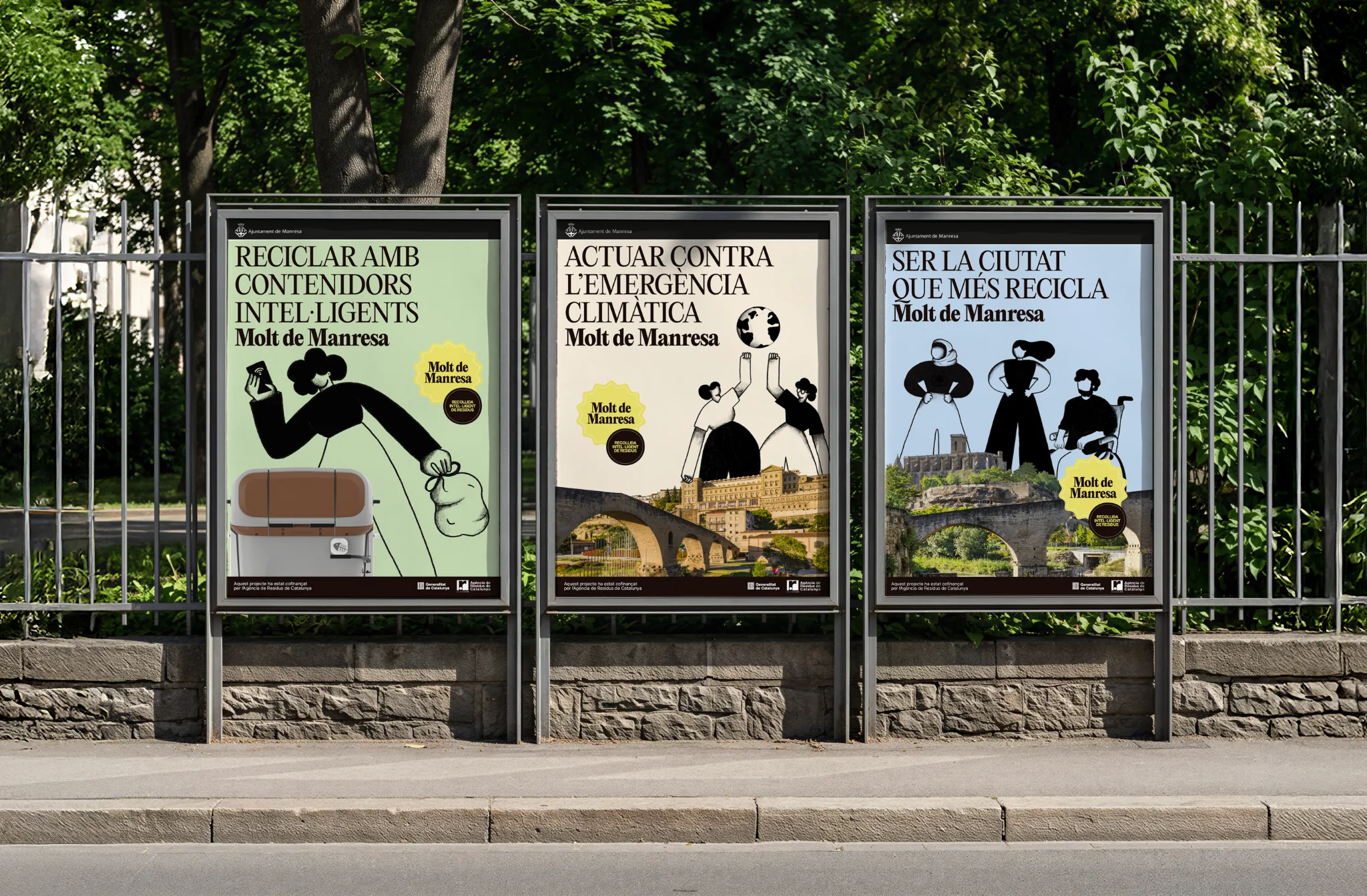
Instead of making the smart bins the stars of the communication, the strategy focused on shared goals: recycling more, taking action on the climate emergency, and building a more mature city characterized by shared responsibility.
This gave rise to Molt de Manresa—a campaign identity linking new recycling habits to a sense of civic pride and the elements that shape the city’s everyday identity.
The project was rolled out via:
- Creation of the “Molt de Manresa” brand identity
- Construcción de un relato vinculado al orgullo de ciudad y la emergencia climática
- Integración del mensaje “Recogida inteligente de residuos” como descriptor del cambio
- Creación de un sistema de mensajes adaptable a distintos contenidos y momentos
- Campaña intensiva de preimplantación e implantación
- Segmentación de la comunicación entre ciudadanía y actividades económicas
- Activation of local figures as advocates for the change
Results
Molt de Manresa is going to convert the implementation of a new collection model into a city campaign, shifting the focus of the functioning of the new systems to the purpose that it had intended to change.
The identity will allow to maintain a coherent communication throughout the different phases and adapt the message to the different audiences and needs of the implementation.
The result is a campaign that does not talk just about containers, targets or door-to-door collection, but rather about Manresa’s ability to act on environmental issues and based on its own identity.
The new model stops being just a new way of collecting waste and becomes part of a way of fer city.